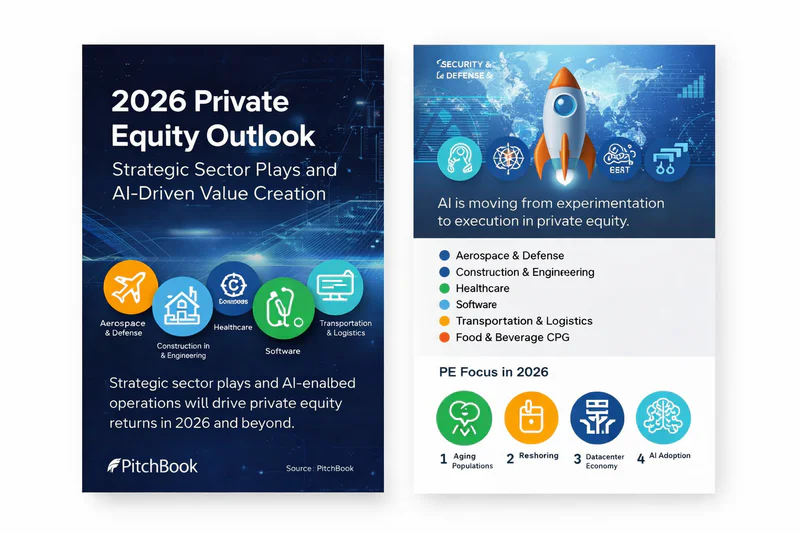
As private equity enters 2026, the industry is undergoing a quiet but meaningful reset. The era of easy multiple expansion driven by cheap capital is over. In its place is a more disciplined environment—one where returns are earned through operational excellence, sector expertise, and intelligent deployment of technology rather than financial engineering alone.
PitchBook’s 2026 Industry PE Outlook: Strategic Themes in a Sector-by-Sector View provides a comprehensive roadmap for how private equity firms are repositioning across mature industries. The report highlights a consistent message across sectors: the most attractive opportunities lie where structural demand, fragmentation, and technology-enabled efficiency intersect.
This article synthesizes the report’s findings into a practical, forward-looking framework for understanding where private equity capital is likely to flow in 2026—and why.
The 2026 Macro Context: Why This Cycle Is Different
Private equity activity in 2026 is shaped by several reinforcing macro forces:
Stabilizing interest rates following multiple Federal Reserve cuts are improving deal economics and financing certainty.
Reshoring and nearshoring are accelerating investment into domestic manufacturing, logistics, energy, and infrastructure.
AI adoption is shifting from experimentation to execution, with tangible impacts on margins, labor productivity, and cash flow.
Demographic shifts, including aging populations, rising healthcare utilization, and polarized consumer spending, are reshaping demand patterns.
Geopolitical uncertainty and regulation are increasing the value of compliant, resilient, and mission-critical platforms.
Together, these dynamics favor mature industries—sectors where demand is durable, operational complexity creates defensibility, and private equity can scale fragmented markets through buy-and-build strategies.
Aerospace & Defense: Durability in an Uncertain World
Aerospace and defense remains one of the most structurally resilient sectors in private equity. The report identifies commercial aerospace parts as the top opportunity heading into 2026, driven by aging aircraft fleets and persistent production bottlenecks at Boeing and Airbus. Airlines are extending the life of existing planes, increasing demand for replacement parts and maintenance components.
Defense electronics is another standout subsector. Rising military budgets—particularly in the US and NATO countries—are fueling demand for advanced avionics, communications systems, sensors, and electronic warfare technologies. These components are deeply embedded in modern defense platforms, offering long-term revenue visibility and strong barriers to entry.
However, not all areas are equally attractive. Maintenance, repair, and overhaul (MRO) businesses have become overcrowded, with elevated valuations and limited margin expansion potential. Defense training and advisory services also face uncertainty as procurement priorities evolve.
From a technology perspective, defense electronics is among the best-positioned subsectors for AI-driven gains, particularly in autonomous systems, targeting, and adaptive communications.
Construction & Engineering: Powering the AI Economy
Construction and engineering is being reshaped by one dominant theme: infrastructure for data and power. Datacenter construction is driving sustained demand for electrical engineering, HVAC, and specialized trades, making these subsectors top priorities for PE investors.
Electrical engineering firms benefit from multiple tailwinds:
Grid modernization
Battery charging infrastructure
Datacenter electrification
Manufacturing reshoring
HVAC follows closely, as cooling requirements for datacenters and smart buildings intensify. Plumbing and metals trades also offer roll-up potential due to extreme fragmentation and predictable cash flows.
Solar, while currently pressured by policy uncertainty and tariffs, is identified as a potential contrarian entry point. Lower valuations and improving technology may create attractive opportunities once incentives stabilize.
AI’s impact in this sector is largely operational—construction technology that integrates sensors, wearables, autonomous equipment, and project management systems can significantly reduce costs, improve safety, and compress timelines.
Consumer Retail & Services: The End of the Middle Market
Consumer markets in 2026 are defined by polarization. Shoppers are either trading down to value or trading up to premium—leaving mid-tier brands increasingly vulnerable.
Health and wellness emerges as the most attractive subsector, driven by chronic disease prevalence, greater health awareness, and data-enabled personalization. Premium brands with pricing power, loyal customers, and strong unit economics continue to attract sponsor interest.
Sports, outdoor, and recreational categories—after struggling post-pandemic—are positioned for recovery as participation rebounds and new formats (e.g., pickleball, women’s sports, digitized training) expand addressable markets.
The pet economy stands out as a long-term roll-up opportunity. Strong emotional attachment, premiumization, and recurring spend support consolidation, particularly in veterinary care, which remains highly fragmented.
AI’s most immediate value in consumer sectors lies in cost containment—content production, merchandising, pricing optimization, and inventory management—rather than flashy customer-facing applications.
Healthcare Services: The Shift Away From Hospitals Accelerates
Healthcare services continue their structural shift away from inpatient hospitals toward lower-cost, outpatient models. Physician practice management (PPM), ambulatory surgery centers (ASCs), and multispecialty clinics are consistently ranked as top investment targets for 2026.
Hospitals, by contrast, face reimbursement pressure, labor shortages, and regulatory uncertainty, making them less attractive from a PE perspective.
What differentiates winning healthcare platforms in 2026 is AI-enabled efficiency. Ambient AI scribes, clinical decision support, and workflow automation materially reduce administrative burden, improve physician productivity, and alleviate burnout. These tools directly expand margins while improving care delivery.
While reimbursement uncertainty has temporarily slowed deal activity in PPM, the report suggests this will ease in 2026, creating renewed consolidation opportunities at more attractive entry valuations.
Healthcare IT: Cost Management Is the Priority
In healthcare IT, private equity interest is firmly concentrated around cost containment solutions. Revenue cycle management (RCM), utilization management, and payment integrity platforms address urgent financial pain points for both providers and payers.
RCM, in particular, is becoming core infrastructure. It underpins AI scribes, automation platforms, and alternative health plan models, making it strategically indispensable.
By contrast, general IT consulting and managed services—once heavily funded—are losing favor as capital shifts toward AI-native platforms with scalable economics.
The broader theme is clear: in healthcare IT, mission-critical systems that directly influence cash flow will command premium valuations.
Medtech: Hardware Over Hype
Medtech presents a more nuanced picture. Surgical devices, diagnostics, and contract manufacturing benefit from aging populations, rising procedure complexity, and reshoring initiatives.
These subsectors offer predictable demand and opportunities for scale, particularly where distribution synergies and centralized reimbursement expertise can be leveraged.
However, AI imaging and surgical robotics are flagged as overheated. Heavy competition, long sales cycles, and constrained hospital budgets make outsized returns harder to achieve in the near term.
AI’s strongest medtech impact is expected in diagnostics and imaging workflows, where automation can improve throughput, reduce errors, and enhance operating leverage without requiring radical changes to care delivery.
Software: Boring Is Beautiful Again
The software sector is undergoing a re-rating. Investors are moving away from growth-at-all-costs models and returning to defensive, mission-critical enterprise systems.
Enterprise management suites—covering payroll, finance, customer service, compliance, and supply chain—are among the safest bets for 2026. These platforms enjoy high switching costs, sticky customers, and recurring revenue.
Customer service and support platforms are particularly attractive as AI-driven reasoning models dramatically reduce human labor costs while improving resolution times and customer satisfaction.
Conversely, analytics, business intelligence, and standalone marketing platforms face intense pressure from hyperscalers that bundle similar capabilities at minimal incremental cost.
In this environment, AI is less about differentiation and more about automation, retention, and margin defense.
Transportation & Logistics: Reset Before Reinvention
Transportation and logistics is emerging from a challenging post-pandemic period. Trucking and warehousing have suffered from overcapacity and pricing pressure, but this downturn is creating consolidation opportunities.
Specialized freight—particularly cold-chain logistics—stands out due to growth in pharmaceuticals and food distribution. Freight forwarding and third-party logistics providers benefit from tariff volatility and increasingly complex trade dynamics.
Autonomous trucking represents a longer-term inflection point. While adoption remains gradual, productivity gains from 24/7 operation and fuel efficiency could fundamentally reshape the industry over the next decade.
Food & Beverage CPG: Function Beats Fashion
Food and beverage investing in 2026 is driven by functional demand, not novelty. Healthier snacks, gut-health beverages, high-protein meals, and portion-controlled formats aligned with GLP-1 adoption are the strongest growth engines.
Overcrowded categories—such as no-/low-alcohol drinks and RTD cocktails—face margin compression due to intense competition and private-label encroachment.
One of the most compelling insights in the report is the role of AI in fresh and prepared foods. AI-driven demand forecasting can significantly reduce waste, improve inventory turns, and recover millions in annual EBITDA for mid-sized operators. In perishable categories, AI is no longer optional—it is existential.
The Unifying Theme: AI as an Operator, Not a Product
Across every sector, the most successful AI deployments share a common trait: they operate behind the scenes.
AI in 2026 is not about chatbots or flashy demos. It is about:
Automating documentation and workflows
Reducing waste and inventory risk
Improving compliance and accuracy
Increasing labor productivity
Expanding margins without revenue risk
Private equity firms that treat AI as an operational lever—rather than a standalone product thesis—are best positioned to outperform.
Final Takeaway: Precision Beats Scale
The 2026 private equity landscape rewards precision, not broad exposure. Winning firms will pair sector specialization with operational rigor, disciplined valuation, and targeted technology deployment.
The opportunity set is not shrinking—it is becoming more selective. And for those willing to execute deeply within sectors, 2026 may prove to be one of the most attractive vintages of the next cycle.