November 9, 2026 — Analyze private credit expansion, LP liquidity management, and fund compliance to ensure operational agility. Book a demo: https://calendly.com/khushboojha/
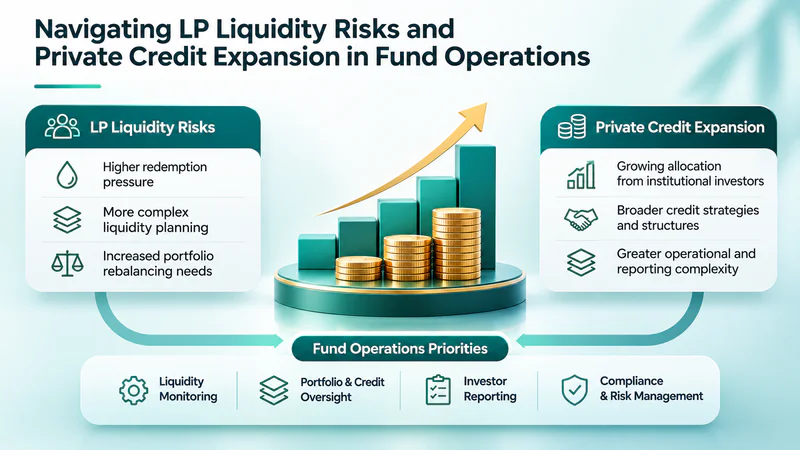
Private markets are undergoing a fundamental transformation. As institutional Limited Partners (LPs) pivot toward nimble mid-market buyout funds and private wealth allocations to venture capital surge, General Partners (GPs) face an increasingly multi-faceted operational landscape.
At the same time, the rapid expansion of multi-strategy hedge funds into evergreen private credit, coupled with tightening redemption deadlines across direct lending vehicles, underscores growing liquidity and regulatory pressures.
With private market allocations outperforming public benchmarks over ten-year horizons, fund managers can no longer afford the operational friction of offline legacy tools. To handle complex asset-backed credit structures, enforce strict valuation governance, and manage LP redemption and capital call workflows, forward-thinking CFOs and Chief Compliance Officers (CCOs) are deploying integrated fund operating infrastructure.
Key Takeaways
Mid-Market and Specialized Fund Momentum: LPs are prioritizing mid-market buyouts and specialized strategies for tighter alignment, demanding real-time operational transparency from GPs.
Private Credit & Evergreen Vehicle Surge: Major multi-strategy platforms are launching evergreen credit funds, introducing complex cash flow matching and multi-feeder accounting challenges.
Liquidity and Redemption Pressures: Looming cash-return deadlines and redemption terms in private credit vehicles require automated, audit-ready liquidity tracking.
Cross-Asset Compliance Governance: Tracking diverse allocations across private equity, venture capital, real estate, and direct lending requires unified ledgers to satisfy SEC examination sweeps.
1. Deconstructing Operational Drag Across Evolving Private Market Assets
Managing operations across parallel funds, evergreen credit vehicles, and multi-tier real estate structures introduces significant operational friction when finance teams rely on offline spreadsheets:
Evergreen & Credit Cash Flow Accounting: Moving from manual loan ledger entries to real-time, automated interest accrual and payment reconciliation.
Redemption & Liquidity Management: Shifting from unverified spreadsheet liquidity tracking to programmatic enforcement of LP redemption locks and gates.
Multi-Feeder Waterfall Recalculation: Transitioning from fragile formula models to automated commitment and distribution engines.
LP Onboarding & Verification: Replacing manual document reviews with self-serve digital onboarding and instant KYC/AML checks.
Valuation Committee Oversight: Moving away from fragmented email chains to centralized digital approval workflows.
Primary Risk Vectors:
Liquidity & Redemption Mismatches: Manual tracking of cash-return deadlines in evergreen or direct lending vehicles leaves CFOs vulnerable to sudden liquidity shortfalls during redemption windows.
Valuation Input Inconsistencies: Applying disparate discount rates or cap rates across parallel funds holding shared assets triggers regulatory red flags and LP disputes.
Audit Fatigue During Regulatory Sweeps: Gathering historical valuation logs, committee sign-offs, and LP allocation records across multi-strategy portfolios consumes hundreds of back-office hours.
2. Regulatory Enforcement: SEC Scrutiny on Illiquid Valuations and Governance
Regulatory priorities in late 2026 place heavy emphasis on how private credit and illiquid asset managers govern valuations, manage liquidity provisions, and allocate fees across complex fund networks. Regulators are actively inspecting:
Valuation Governance Adherence: Evaluating whether GPs strictly adhere to documented valuation policies or apply ad-hoc overrides on hard-to-value assets during market shifts.
Liquidity Term Transparency: Inspecting whether redemption terms, gate provisions, and asset markdowns are clearly disclosed and consistently applied without favoring specific LP classes.
Expense & Fee Allocation Parity: Verifying that shared operational expenses, broken-deal costs, and management fee offsets across flagship and co-investment vehicles are programmatically applied.
3. How Connected Infrastructure Automates Multi-Strategy Fund Operations
Modern private market operating platforms unite fund accounting, credit tracking, LP communications, and compliance oversight into a single connected system.
Automated Loan & Cash Data Ingestion
Connected platforms ingest bank ledgers, payment schedules, and administrator feeds directly via secure APIs. The system automatically reconciles incoming cash, interest distributions, and principal repayments, flagging variances instantly.
Programmatic Valuation Governance
Valuation models are integrated directly into the core general ledger workflow. As deal teams update discount rates or financial multiples, the engine recalculates asset values across all parallel holding entities, enforcing consistent ASC 820 classification protocols.
Centralized Operational & Compliance Vault
Compliance managers, CFOs, and valuation committees sign off on asset marks, transfer approvals, and capital calls within an encrypted compliance portal. Every adjustment, timestamp, and supporting document is automatically logged into an immutable audit trail.
Conclusion: Driving Scale Through Operational Excellence
Operational agility, transparent governance, and robust liquidity management are essential for building long-term LP trust. General Partners can no longer rely on manual spreadsheets or disconnected point solutions to manage complex private market portfolios. By deploying automated fund accounting and compliance infrastructure, CFOs ensure absolute ledger precision, mitigate regulatory exposure, and scale their platforms seamlessly.
Learn how Ashta.ai unifies multi-entity fund accounting, automated LP onboarding, and compliance governance into a single connected platform built for modern private market managers.
In summary, as private markets expand into AI infrastructure, asset-backed credit, and evergreen fund structures, success in late 2026 will be defined by operational agility and precision. General Partners who replace manual legacy workflows with unified, automated operating infrastructure will be best positioned to mitigate cyber risks, ensure compliance, and deliver seamless LP experiences at scale.