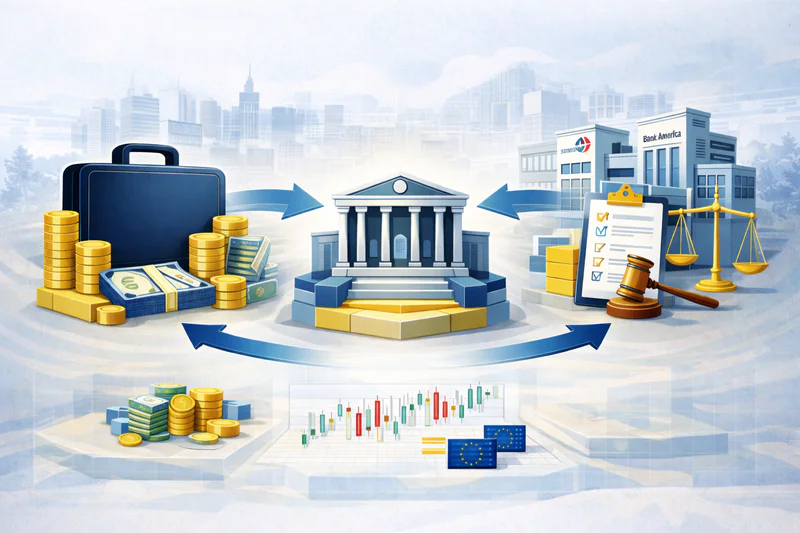
In early 2026, the global financial system reached an inflection point as private capital, traditional banking, and regulatory frameworks intersected in unprecedented ways. From a €750 million private capital rescue of an Italian bank to evolving roles for major U.S. lenders and intensifying regulatory pressures on asset managers, the industry is being reshaped in real time. At the same time, market milestones driven by artificial intelligence and debates around central bank independence and crypto regulation are adding complexity. Together, these developments highlight how capital providers and regulators are redefining stability, risk, and growth in a rapidly evolving financial landscape.
Private Capital Rescues and Banking Evolution in a Changing Regulatory Era
The financial industry is undergoing a structural transformation. Private capital is stepping in where traditional banking constraints remain tight, while regulators and policymakers recalibrate oversight amid technological disruption and historic market milestones.
Recent developments—including large-scale private capital bank rescues, strategic banking expansions, and regulatory debates—offer a window into how financial power structures are shifting. Understanding these dynamics is critical for investors, banks, and policymakers navigating the next phase of global finance.
The Growing Role of Private Capital in Banking Stability
Private capital has emerged as a critical stabilizing force for financial institutions under stress. A prominent example is Oaktree Capital Management’s €750 million rescue of Banca Progetto in Italy.
Such interventions highlight how private investors are increasingly willing to provide liquidity where traditional funding channels fall short. Beyond balance-sheet repair, these transactions often bring operational restructuring, governance oversight, and long-term strategic repositioning.
Strategic Implications
For banks, private capital offers a lifeline—but often at the cost of greater oversight and strategic change. For investors, these rescues represent opportunities to deploy capital into distressed or transitional assets with asymmetric return potential.
Evolution of Traditional Banking Models
Traditional banking models are adapting as competition, technology, and capital requirements reshape the industry. Deutsche Bank and DWS Group’s consideration of acquiring stakes in Fosun-controlled firms reflects a broader strategy of diversification and risk rebalancing.
At the same time, U.S. banking giants are redefining their role in public-private financial initiatives. Bank of America and JPMorgan Chase matched government contributions to the Trump Accounts, signaling a deeper integration between policy objectives and banking services.
Strategic Implications
Banks are no longer just intermediaries—they are becoming partners in economic policy execution, product innovation, and long-term capital formation.
Regulatory Shifts Reshaping Asset Management
Regulatory pressure is intensifying, particularly in Europe, where asset managers face higher compliance costs and stricter transparency requirements. These conditions have inadvertently favored large U.S. passive investing firms, which benefit from scale and standardized product offerings.
Concerns surrounding the independence of the Federal Reserve add further complexity. Political scrutiny of central banking decisions introduces uncertainty into monetary policy execution, with potential implications for market stability and investor confidence.
Crypto and Regulatory Compromise
Meanwhile, discussions led by the White House on crypto-bank regulatory compromises highlight the challenge of integrating digital assets into traditional financial systems. Regulators are attempting to strike a balance between innovation, consumer protection, and systemic risk.
Market Milestones and Technological Disruption
Despite regulatory and macroeconomic uncertainty, markets continue to reach historic highs. The S&P 500 recently crossed the 7,000 threshold, driven largely by optimism around artificial intelligence and productivity gains.
AI-driven efficiencies are reshaping investment strategies, risk modeling, and capital allocation. However, rapid technological adoption is also creating operational stress points. UBS’ reported capacity constraints in dollar hedging underscore the challenges banks face in managing risk in increasingly volatile and technology-driven markets.
What This Means for the Financial Industry
A System in Transition
The convergence of private capital rescues, evolving banking roles, and regulatory recalibration signals a financial system in transition. Private capital is filling structural gaps, banks are redefining their economic role, and regulators are racing to keep pace with innovation.
Strategic Takeaways
Private capital will continue to play a decisive role in financial stability
Banks must balance innovation with risk and compliance
Regulators must adapt without stifling growth
Technology will remain both a catalyst and a stressor
Institutional Capital as a Systemic Backstop
As market volatility, regulatory recalibration, and technological disruption converge, institutional capital is increasingly acting as a systemic backstop for the global financial system. Private capital providers are no longer simply return-seeking investors; they are becoming essential participants in maintaining market continuity, absorbing risk, and facilitating structural transitions within banking and asset management. This shift elevates the importance of long-term alignment between capital providers, regulators, and financial institutions, as stability in the next phase of global finance will depend not only on innovation and growth, but on coordination, governance, and disciplined capital deployment.
Conclusion: Navigating the Next Phase of Global Finance
The financial landscape in 2026 sits at a critical crossroads. Private capital is reshaping banking stability, traditional institutions are evolving beyond legacy models, and regulatory frameworks are being stress-tested by technology and market scale.
For investors, banks, and policymakers, success will depend on adaptability, disciplined risk management, and strategic collaboration. Those who understand how private capital, regulation, and innovation intersect will be best positioned to navigate—and shape—the future of global finance.