November 6, 2026 — Analyze private credit liquidity risks, rising defaults, and real estate valuation shifts to maintain audit readiness. Book a demo: https://calendly.com/khushboojha/
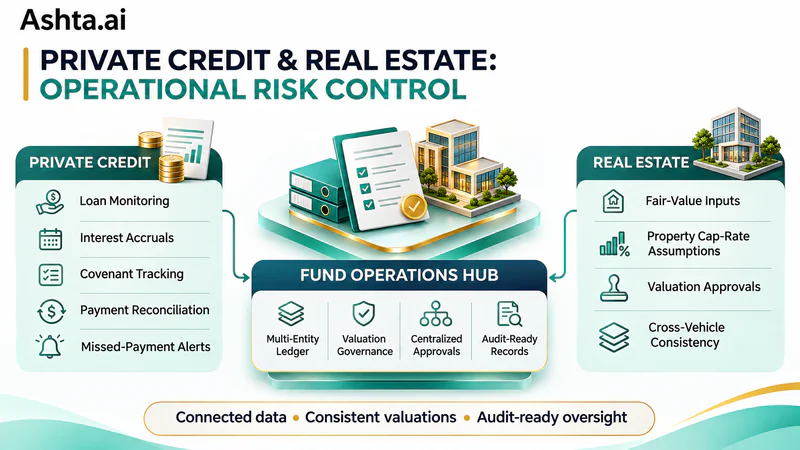
The illiquid asset landscape is confronting a dual operational challenge. Rising interest rates and slowing business growth have elevated default risks across direct lending portfolios, while commercial real estate fund managers pivot toward asset-first strategies to handle complex capital structures.
With middle-market direct-lending defaults surging by 22% quarter-over-quarter and a massive debt wall maturing over the next two years, Chief Financial Officers (CFOs) and Chief Compliance Officers (CCOs) can no longer rely on fragmented legacy spreadsheets.
To manage complex multi-feeder cash flows, satisfy heightened Limited Partner (LP) due diligence, and meet regulatory valuation standards, forward-thinking General Partners (GPs) are deploying unified fund accounting and automated compliance infrastructure.
Key Takeaways
Surging Direct Lending Defaults: Middle-market borrower defaults have hit record highs, making automated credit monitoring and real-time loan tracking essential for private credit GPs.
Shift to Asset-Backed Finance (ABF): Capital flows are shifting rapidly into asset-backed credit and AI infrastructure financing, requiring multi-entity ledgers capable of handling hybrid debt-equity assets.
Real Estate Special Situations: Real estate fund managers are adopting 'asset-first' investment models and single-asset continuation vehicles, driving the need for flexible waterfall and valuation governance.
Audit-Ready Credit Ledger: Maintaining a single source of truth across bank feeds, valuation inputs, and LP call schedules protects funds during SEC examination sweeps.
1. Operational Drag in Complex Credit and Real Estate Portfolios
Managing non-performing loans, workout scenarios, and special situation real estate structures across parallel vehicles introduces significant back-office friction:
Direct Lending Tracking: Shifting from manual loan monitoring to automated interest accrual, covenant tracking, and payment reconciliation.
Fair Value Input Audit Trails: Replacing unverified markdown assumptions with an immutable, programmatic valuation log for ASC 820 compliance.
Multi-Feeder Cash Flows: Transitioning from fragile spreadsheet formulas to an automated, multi-entity waterfall engine.
Default & Distressed Management: Moving from reactive error detection to automated discrepancy and missed-payment alerts.
Valuation Committee Governance: Replacing offline approval threads with centralized digital approval workflows.
Primary Risk Vectors:
Reconciliation Lag During Restructurings: Manual matching of payment notices against internal ledgers causes delays during debt restructurings, leaving CFOs blind to cash position changes.
Valuation Policy Deviations: Applying inconsistent discount rates or recovery assumptions across parallel credit vehicles creates misaligned NAV calculations, triggering regulatory red flags.
Audit Fatigue: Gathering historical valuation committee notes, deal memo adjustments, and workout logs for annual audits or regulatory exams consumes hundreds of hours of team time.
2. Regulatory Enforcement: SEC Scrutiny on Asset Markdowns
Regulatory priorities in late 2026 focus heavily on how private credit and real estate managers mark hard-to-value illiquid assets during market shifts. Regulators are actively reviewing:
Valuation Policy Adherence: Verifying that GPs strictly follow documented valuation policies rather than applying manual overrides to delay asset write-downs.
Carry Calculation Integrity: Ensuring unrealized asset marks used for performance fee calculations or carried interest distributions reflect verifiable market inputs.
Cross-Vehicle Valuation Parity: Confirming that co-investment vehicles, flagship funds, and continuation vehicles apply identical fair value marks to shared assets.
3. How Connected Infrastructure Automates Credit and Real Estate Operations
Modern private market operating platforms unite multi-entity fund accounting, credit tracking, and valuation governance into a single connected system.
Automated Bank and Loan Data Ingestion
Connected platforms ingest bank feeds and payment logs directly from fund administrators and direct-lending agents via secure APIs. The engine automatically reconciles cash balances, interest payments, and principal payments, flagging line-item variances immediately.
Programmatic Valuation Governance
Valuation models are built directly into the operating workflow. As deal teams update discount rates, EBITDA multiples, or property cap rates, the platform recalculates asset values across all holding entities while enforcing consistent ASC 820 classification rules.
Centralized Approval Workflows
Valuation committee members review, challenge, and approve asset marks within a secure compliance portal. Every change, commentary, and supporting document is automatically logged to maintain a permanent audit trail.
Conclusion: Driving Precision Across Illiquid Strategies
Operational agility and transparent governance are vital for maintaining institutional LP trust. General Partners can no longer rely on manual spreadsheets to monitor complex loan portfolios or defend real estate marks. By deploying automated fund accounting and valuation governance infrastructure, CFOs ensure absolute ledger accuracy, mitigate regulatory exposure, and scale their funds seamlessly.
Learn how Ashta.ai unifies multi-entity fund accounting, automated LP onboarding, and compliance governance into a single connected platform built for modern private market managers.
In summary, as private markets expand into AI infrastructure, asset-backed credit, and real estate special situations, success in late 2026 will be defined by operational agility and precision. General Partners who replace manual legacy workflows with unified, automated operating infrastructure will be best positioned to mitigate cyber risks, ensure compliance, and deliver seamless LP experiences at scale.