SEO Meta Description: Analyze late 2026 alternative investment trends, including BlackRock's $205B AI infrastructure push, asset-backed finance growth, and middle-market PE dynamics.
October 2026 marks a pivotal period for alternative investments, characterized by strategic capital deployment, technological convergence, and expanding institutional demand. As traditional public markets face persistent macroeconomic volatility, alternative assets offer institutional investors essential avenues for yield generation, inflation hedging, and portfolio diversification.
From mega-cap infrastructure initiatives to niche private credit strategies, the private markets landscape continues to evolve rapidly across all primary asset classes.
Below is an analysis of the structural shifts, capital flows, and sector-specific strategies defining private markets in late 2026.
Key Takeaways
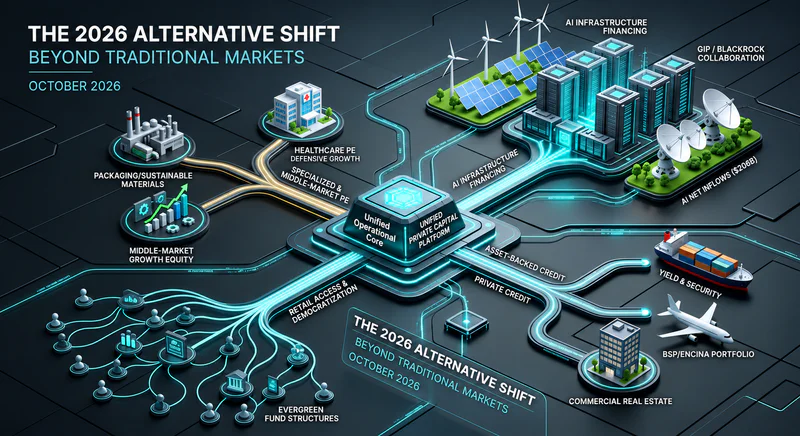
AI Infrastructure Scale: BlackRock secured $205 billion in net inflows, bringing private market assets to $336 billion and fueling large-scale AI infrastructure projects.
Asset-Backed Credit Expansion: Benefit Street Partners acquired a $480 million credit portfolio, emphasizing the demand for yield backed by hard assets in a higher-for-longer rate environment.
PE Middle-Market Resilience: Significant raises—including Spectrum Equity’s $2.5 billion fund and Investcorp’s $1.22 billion close—highlight strong LP appetite for specialized and middle-market buyouts.
Retail Democratization: Evergreen fund structures, such as Adams Street’s $363.5 million vehicle, are expanding private market access to high-net-worth and wealth management channels.
1. AI Infrastructure Captures Institutional Capital
BlackRock’s announcement of $205 billion in quarterly net inflows underscores the massive institutional pivot toward technology-adjacent infrastructure. In collaboration with Global Infrastructure Partners, HPS Investment Partners, and MGX, BlackRock is leading multi-billion-dollar financing initiatives targeting compute capacity and data center infrastructure.
This strategy directly aligns with broader venture capital trends identified by J.P. Morgan, where AI deployment remains the primary driver of deal activity. Venture capital concentration continues to intensify around companies with direct access to compute and power infrastructure. With total private market assets reaching $336 billion, BlackRock’s expansion demonstrates how artificial intelligence is transforming core infrastructure into a primary alternative asset class.
2. Asset-Backed Finance and Specialized Lending
Private credit managers are increasingly moving into specialized and asset-backed finance (ABF) to secure yield and collateral protection.
Portfolio Expansion: Franklin Templeton’s Benefit Street Partners (BSP) acquired a $480 million specialty portfolio from Encina alongside a 14-person investment team, demonstrating platform expansion through targeted acquisitions.
Higher-for-Longer Rates: As highlighted by Brookfield Credit, persistent higher interest rates make asset-backed credit structures particularly compelling for institutional allocators seeking risk-adjusted returns.
Niche Intellectual Property Lending: MEP Capital’s specialized lending strategy targets media and digital entertainment rights, using high-demand intellectual property as collateral to capture yield in underserved credit markets.
3. Middle-Market Buyouts and Sector-Focused PE
Despite ongoing valuation gap challenges highlighted by research firm Ducker Carlisle, private equity managers with dedicated sector expertise continue to execute transactions and raise capital:
Targeted Acquisitions: Grafine Partners and Atlantic Ridge Capital completed a $900 million acquisition of Paragon Films from Rhône, illustrating resilience in specialized manufacturing and sustainable packaging.
Successful Fundraisings: Spectrum Equity closed a record $2.5 billion fund, while Investcorp closed its North American Private Equity Fund II at $1.22 billion, exceeding its $1.1 billion target.
Defensive Sector Conviction: Consonance Capital reached its $1.35 billion hard cap for its healthcare-focused PE vehicle, confirming LP preference for defensive, resilient market segments.
4. Real Assets, Infrastructure, and Retail Democratization
Renewable Energy Infrastructure
Private capital continues to power the energy transition regardless of federal policy shifts. KKR and TotalEnergies expanded their US solar joint venture with a $1.2 billion portfolio, modeling how financial sponsors and corporate energy majors co-invest at scale.
Real Estate and Aviation Strategies
In real estate, LaSalle Investment Management appointed new leadership for its $10 billion indirect platform. Simultaneously, real assets outside core real estate saw notable gains, evidenced by BBAM closing Incline Aviation III above $1.7 billion.
Pension Allocations and Evergreen Structures
Institutional allocators like KCERA ($150 million across quantitative equity, credit, and real estate debt) and LACERA ($275 million private markets commitment) continue expanding alternative programs. Concurrently, vehicles like Adams Street’s $363.5 million venture and growth evergreen fund are accelerating the democratization of private markets for wealth management clients.
Conclusion: Adapting to Structural Market Shifts
The alternative investment landscape in late 2026 is defined by rapid scale, asset class convergence, and structural product innovation. From mega-cap AI infrastructure partnerships to niche credit strategies and evergreen structures, successful participation requires both market discipline and modern operational infrastructure.
Modern fund managers must leverage unified operating systems to streamline compliance, automate complex accounting workflows, and maintain institutional transparency across expanding asset classes.
Learn how Ashta.ai unifies investor onboarding, fund accounting, and multi-asset compliance into a connected operating environment for private market managers.
In summary, as private markets expand into AI infrastructure, asset-backed credit, and evergreen fund structures, success in late 2026 will be defined by operational agility and precision. General Partners who replace manual legacy workflows with unified, automated operating infrastructure will be best positioned to mitigate cyber risks, ensure compliance, and deliver seamless LP experiences at scale.